CHARAMA ROCK PAINTINGS
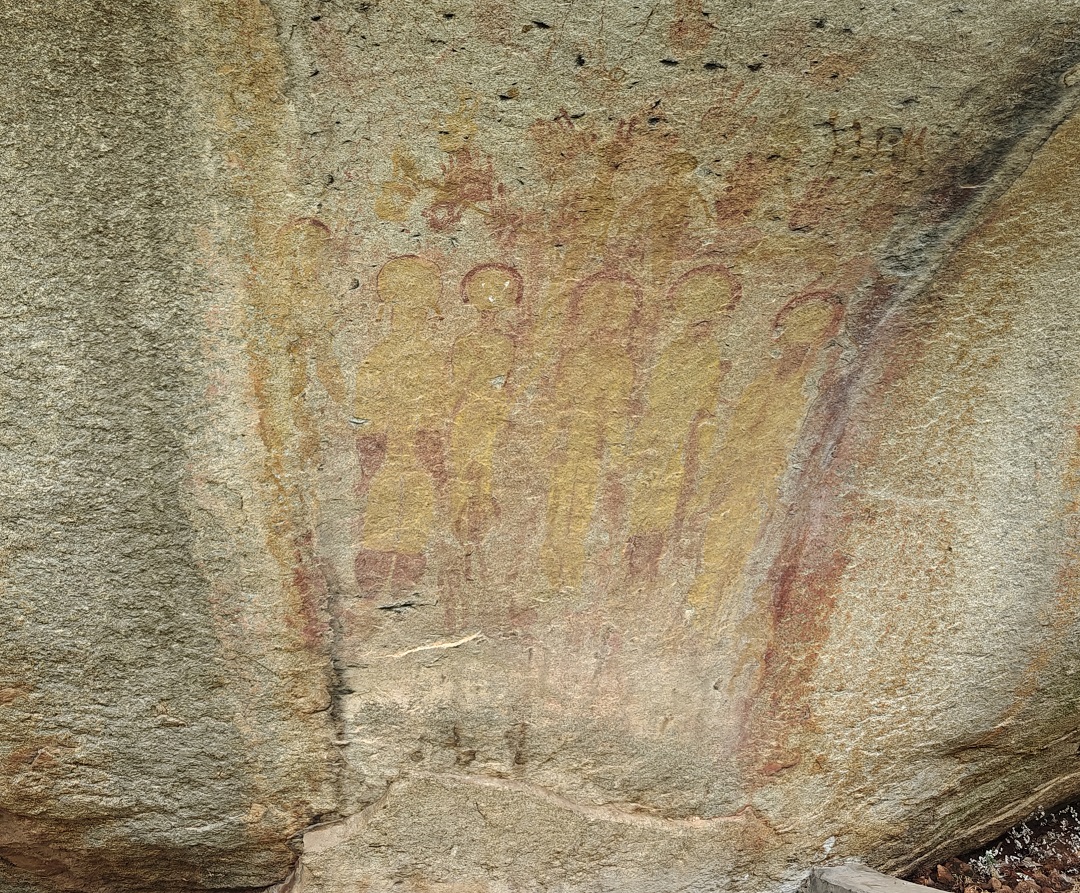
Deep within the lush forests and undulating hills of Kanker district in southern Chhattisgarh lies one of India’s most mysterious archaeological sites — the Rock Art near Charama. These cave paintings, found in remote rock shelters, have fascinated archaeologists, historians, and even UFO enthusiasts for their enigmatic depictions of human-like figures with large heads and disc-shaped objects. Thought to belong to the Mesolithic period (approximately 8,000–10,000 years ago), these paintings offer an extraordinary window into prehistoric life — revealing the beliefs, rituals, and imagination of ancient people who once inhabited this region.
---
1. Geographical and Archaeological Context
The Charama rock art sites are located about 125–130 kilometers south of Raipur, the capital of Chhattisgarh, and approximately 40 kilometers north of Kanker town. The area lies along the Kanker–Charama–Raipur route on National Highway 30, making it relatively accessible for visitors interested in archaeology and ancient art.
The terrain around Charama is characterized by dense sal forests, undulating hills, and sandstone cliffs, which provided ideal natural shelters for prehistoric communities. Over millennia, these natural caves became canvases for early human creativity and spiritual expression. The rock shelters are spread across small hillocks and ravines, and several contain well-preserved pictographs in red and white pigments made from natural minerals such as hematite and lime.
The region is part of the larger Central Indian Rock Art Belt, which extends across Madhya Pradesh, Chhattisgarh, and parts of Odisha. Other well-known sites in this belt include Bhimbetka (a UNESCO World Heritage Site) and Singhanpur near Raigarh, Chhattisgarh — both of which display stylistic similarities with the Charama paintings.
---
2. Discovery and Research
The Charama rock paintings first came to academic attention in the early 21st century when archaeologist J. R. Bhagat, working with the Chhattisgarh State Department of Archaeology and Culture, documented several rock shelters containing unique and puzzling images.
Bhagat’s discovery gained widespread attention due to the presence of “alien-like” figures and disc-shaped objects, which he described as “resembling UFOs.” These depictions generated both scientific curiosity and public fascination, as they seemed to challenge conventional understandings of prehistoric symbolism.
Bhagat noted that the local villagers referred to these figures as the “Rohela people”, described in folklore as beings who “descended from the sky in round objects.” This folklore, combined with the uncanny imagery, led to speculation about extraterrestrial contact — a theory that has no scientific basis but has become a compelling part of the site’s mythos.
Since its discovery, the site has been the subject of ongoing archaeological and anthropological study, with researchers attempting to decode the symbolism of the images within the broader cultural context of prehistoric India.
---
3. Description of the Rock Art
The Charama rock shelters contain figurative and symbolic paintings executed mainly in red ochre, white clay, and black pigments. The scenes portray both daily life and ritual activities, including hunting, dancing, and social gatherings.
- Among the most intriguing images are:
- Humanoid figures with large, elongated heads and headgear-like shapes.
- Disc-shaped flying objects, some with radiating lines or extensions resembling rays.
- Human and animal figures engaged in dynamic activities such as hunting, dancing, and rituals.
- Geometric and abstract symbols, possibly representing weapons, tools, or celestial objects.
The pigments used have endured thousands of years due to the mineral composition of the sandstone and the protected microclimate within the caves. Some paintings are still remarkably vivid, showing fine detail in outlines and posture.
---
4. Interpreting the Enigmatic Figures
Archaeologists generally interpret prehistoric rock art through ethnographic analogy and comparative symbolism rather than literal readings. While some popular writers have claimed that the figures represent “ancient astronauts,” most scholars propose more grounded explanations:
a. Shamanic or Ritual Symbolism
The large-headed figures may represent shamans wearing elaborate masks or headdresses during trance-like rituals. Similar depictions have been found in other Mesolithic sites, where altered states of consciousness and communication with spirits were central to religious life.
b. Spiritual or Mythological Beings
The images could symbolize supernatural entities or deities in early tribal cosmology — beings that mediated between humans and nature. Their unusual features may emphasize their otherworldly or divine character.
c. Celestial Phenomena
The disc-like shapes may represent the sun, moon, or stars, or symbolic renditions of spiritual journeys between the earthly and celestial realms. Prehistoric people were often keen observers of the sky, and their art reflects cosmological beliefs rather than physical spacecraft.
d. Cultural Memory and Myth
Over time, oral traditions may have transformed these symbols into stories of sky beings — the “Rohela people” — who descended to Earth. Such transformations are common in cultures where myth and memory intertwine.
Thus, while the “alien” hypothesis remains popular in media narratives, the academic consensus leans toward symbolic, ritualistic, or spiritual interpretations consistent with prehistoric cultural patterns.
---
5. Dating the Paintings
The Charama rock paintings are broadly dated to the Mesolithic period, approximately 8,000–10,000 years before present, based on stylistic comparison with other dated sites in Central India. However, absolute dating (such as radiocarbon or uranium-thorium analysis) has not yet been conclusively applied to these pigments.
The use of red ochre, human-animal compositions, and hunting scenes aligns them with Middle to Late Stone Age art traditions found across India. The layering of figures suggests multiple phases of painting — possibly by different groups over thousands of years.
---
6. The Legend of the “Rohela People”
Among local tribes and villagers around Charama, stories persist of mysterious beings called the “Rohela” — described as tall, fair-skinned visitors who came from the sky in circular objects and took away some villagers who never returned. These legends, passed down through generations, are recounted during festivals and storytelling gatherings.
While these myths likely arose from symbolic interpretations of the paintings themselves, they offer valuable insight into the living cultural memory that surrounds the site. In many indigenous traditions, sky beings or celestial visitors are common motifs representing ancestral spirits or divine messengers.
The “Rohela” legend thus adds a layer of living folklore to the ancient art, making Charama not just an archaeological site but also a living heritage landscape.
---
7. Preservation and Challenges
Despite its importance, the Charama rock art remains largely unknown and under-protected. The shelters lie in forested areas accessible only by narrow trails, and lack formal signage, fencing, or interpretation centers.
- Threats to the site include:
- Erosion and weathering of sandstone due to exposure.
- Graffiti and vandalism by unaware visitors.
- Vegetation growth that damages pigment layers.
- Unregulated tourism without conservation oversight.
The Chhattisgarh State Archaeology Department and local heritage enthusiasts have called for greater protection, public awareness, and responsible tourism development to ensure these priceless artworks survive for future generations.
---
8. Travel Information
Location:
- Charama, Kanker District, Chhattisgarh, India
---
9. Things to Do
1. Explore the Rock Shelters:
- View the ancient paintings firsthand with a local guide who can explain their context and stories.
2. Visit Kanker Palace Heritage:
- Stay at the Kanker Palace, which often assists heritage tourists and researchers visiting nearby archaeological and tribal sites.
3. Tribal Cultural Interaction:
- Meet local Gond and Muria artisans, learn about their traditional art forms such as Dhokra metalwork and terracotta sculpture, which carry echoes of ancient symbolism.
4. Nature and Forest Trails:
- Explore the lush Keshkal Valley and Tatamari viewpoint, known for scenic landscapes and birdlife.
---
10. Do’s and Don’ts for Visitors
1. Respect the site: Treat it as a sacred and historic space.
2. Hire a local guide: This supports local livelihoods and ensures responsible access.
3. Take photographs responsibly: Avoid flash, which can damage pigments.
4. Report vandalism: If you notice any graffiti or damage, inform local authorities or the Archaeology Department.
5. Stay on marked paths: Protect the surrounding flora and rock surfaces.
6. Educate others: Share information about the site’s importance and fragility.
7. Carry water and essentials: Facilities are limited in the area.
1. Do not touch or scratch the paintings. The pigments are ancient and fragile.
2. Do not make new marks or graffiti.
3. Avoid loud noise or littering. Preserve the peace of the forest environment.
4. Do not remove any rocks, stones, or artifacts.
5. Do not visit during heavy rains or without proper guidance.
---
11. Significance and Legacy
The rock art of Charama represents more than prehistoric decoration — it is a testament to humanity’s evolving mind, imagination, and relationship with the cosmos. Whether viewed through an archaeological lens or as a living cultural symbol, it reveals the deep continuity between the ancient and the modern human spirit.
From hunters who painted their beliefs on stone walls to villagers who still tell stories of the Rohela sky people, Charama stands as a bridge across time — linking ancient artistry, mythology, and mystery in one timeless landscape.
As global awareness grows around intangible cultural heritage, sites like Charama remind us that even remote corners of India hold universal stories — of wonder, of the unknown, and of humankind’s eternal quest to understand its place in the universe.
___
Visit Now

https://incrediblechhattisgarh.traviyo.in/forum/heritage
.
Whatsapp link